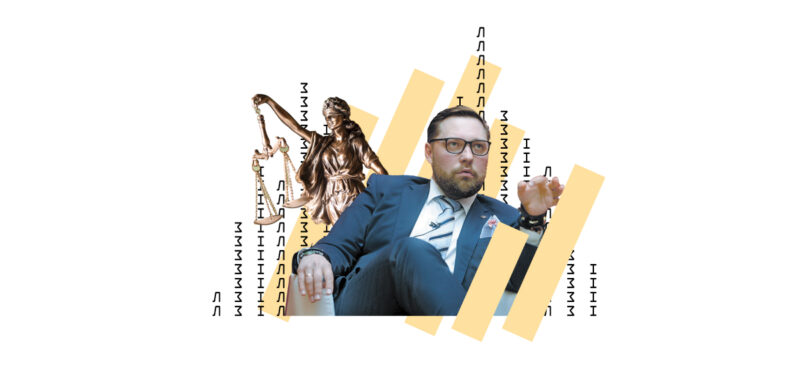

Much has been said about the judgment of the European Court of Human Rights (ECtHR) concerning former judge Oleksii Tandyr — primarily in terms of a possible opportunity for Tandyr to evade liability in the case concerning a fatal drink-driving road accident. However, at most, the judgment allows for a review of the preventive measure applied to the former judge, taking into account the ECtHR’s critical remarks. The case will continue to be examined by the court. Therefore, hope for justice — remains.
At the same time, the judgment once again highlighted a whole ‘bouquet’ of problems within the criminal justice system — excessive length of judicial proceedings, detention without proper substantiation of the risks of absconding from trial and similar issues. Moreover, it is not an isolated case: previously, the ECtHR had already drawn attention to the problem of the quality of reasoning in decisions on pre-trial detention, specifically in the case of Ignatov v. Ukraine (2016), while such problems had also existed under the old Criminal Procedure Code of Ukraine (CPC of Ukraine) of 1960 — Kharchenko v. Ukraine (2011).
What should be changed to reduce the number of ECtHR judgments against Ukraine? Yevhen Krapyvin, Head of the ‘Law and Order’ Area at the Agency for Legislative Initiatives, draws attention to the following:
- The problem lies in the length of investigations and insufficient control over the implementation of preventive measures in criminal proceedings (primarily detention). First and foremost — and most simply — amendments should be introduced to the CPC of Ukraine to ensure that, at the trial stage, a 12-month limit applies to the maximum duration of this preventive measure, including any extensions (by analogy with the pre-trial investigation stage). At present, the average duration of court proceedings in cases concerning serious and especially serious crimes amounts to 3–5 years, or even longer. It is also necessary to consider current conditions, where the length of proceedings is extended due to a shortage of judges, air raid alerts leading to adjournments of hearings and similar factors.
- Another problem concerns the abuse of procedural rights by the parties to criminal proceedings. The CPC of Ukraine addresses abuse of rights only in relation to motions for recusal and excessively lengthy opening statements. In all other instances — failure of all defence counsel to appear, ‘flooding’ the court with identical motions, various attempts to delay the judicial proceedings — such conduct effectively remains the ‘norm’ in criminal procedure. Unfortunately, the disciplinary bodies of the prosecution service or the Bar respond to such behaviour extremely moderately and interpret violations of professional ethics in a very limited manner. As a result, criminal proceedings that could — and should, as a matter of priority — be examined within one year may instead last five, or even ten, years.
- Another shortcoming is the excessive workload of forensic institutions, which may take months to complete even the simplest expert examinations. This significantly slows down criminal proceedings. Even more problematic is the availability of alternative and repeated expert examinations. Of course, the parties are entitled to request them, and this corresponds to the adversarial principle of criminal procedure. However, in practice, this often leads to unlawful conduct by specialists, as improper influence on expert institutions remains widespread. It is precisely for this reason that NABU and SAPO increasingly speak of the need for an ‘independent examination’, while the Ministry of Justice is working to improve forensic activities. State strategic policy documents provide for a review of the legislative framework in this field, so that law enforcement bodies may gain access to ‘high-quality, objective and prompt forensic examination’. This includes the introduction of a new system for licensing experts, ensuring the functioning of expert self-governance, expanding the types of examinations that private forensic experts may conduct, digitalisation of forensic activities and similar measures.
- Another problem concerns supervision over compliance with preventive measures, that is, the functioning of a law enforcement structure capable of monitoring compliance with the obligations imposed — not to tamper with evidence, not to communicate with certain individuals, to remain within a specified territory and similar requirements. While the latter may still be monitored, the destruction of evidence, pressure on victims and witnesses, or the possibility of committing other offences are difficult to prevent due to the lack of time and resources within the police. Alternatives may include house arrest or bail, yet even these provide only weak guarantees of the suspect’s or accused’s participation in criminal proceedings, as the law enforcement infrastructure in this segment remains underdeveloped — and there is no corresponding demand for its development. Judges, for their part, are more inclined to order detention wherever possible. Any other decision concerning a less restrictive preventive measure will inevitably be met with allegations of ‘evasion of justice’ and may provoke public outrage.
Amendments to legislation resolve this systemic problem only partially. It is also advisable to change attitudes towards alternative preventive measures to detention that are not associated with restrictions on freedom of movement. This would contribute to addressing the problem. At the same time — strict supervision must be ensured in relation to house arrest, bail and other measures designed to prevent pressure on witnesses or victims, destruction of evidence or absconding. In other words, preventive measures must achieve their purpose — ensuring the participation of the accused and preserving the evidentiary basis necessary to establish a person’s guilt beyond a reasonable doubt.