
Establishing a System for Transition from Military Service to Civilian Life
The Problem
Following the outbreak of the Russo-Ukrainian war in 2014 and the full-scale invasion in 2022, the return of combatants to civilian life and their full reintegration has become one of the key challenges of state policy. Ukraine already has over 2 million veterans, and once the active phase of the war ends their number will rise significantly. At the same time, the current system of support for veterans remains fragmented and is largely based on approaches formed back in the early 1990s.
The principal legislative act in the field of support for veterans and their families is the Law of Ukraine ‘On the Status of War Veterans and Guarantees of Their Social Protection’, adopted in 1993. This Law does not establish a coherent system of state veterans policy; it regulates matters of status and sets out more than 20 benefits, only a few of which work in practice. The regulation of other aspects of veterans support is scattered across dozens of laws and items of subordinate legislation. This leads to the duplication of provisions, gaps in legal regulation and difficulties in accessing services and support.
A further problem is the absence of a legally regulated mechanism for the transition from military service to civilian life. As a result, veterans often face difficulties in accessing medical assistance, mental and psychological support, professional retraining, employment, the launch of their own business, the receipt of social services and participation in community life.
The situation is compounded by insufficient coordination among state authorities, local self-government bodies, healthcare institutions, employment services and other actors that provide services to veterans.
The existing system does not take into account the importance of communities as the principal actor in delivering veterans’ reintegration measures. There is also uneven access to services depending on the community of residence, a shortage of trained specialists — particularly in psychological support, rehabilitation and social care — and the insufficient adaptation of many state services to the specific needs of veterans.
The need to create a comprehensive state veterans policy and a system for the transition from military service to civilian life is reflected in the Veterans Policy Strategy until 2030.
The need to develop a comprehensive state veterans policy corresponds to Ukraine’s commitments in the spheres of social policy, employment and inclusion within the process of accession to the European Union.
The European Commission’s Ukraine 2025 Report points to the need to promote the integration of veterans into the labour market and to safeguard the rights of persons with disabilities, whose number is growing as a result of the war.
The need to develop a comprehensive system of support for veterans and their reintegration is also noted in the European Parliamentary Research Service (EPRS) briefing ‘Ukraine’s Veterans Policy’ (2026), which regards veterans as one of the key resources for the country’s post-war recovery.
In June 2026, the mandate of the EU Advisory Mission for Civilian Security Sector Reform Ukraine (EUAM Ukraine) was expanded, addingCouncil of the European Union. ‘EUAM Ukraine: Council broadens the Mission’s mandate to counter hybrid threats and support veteran reintegration’. Press release, 11 May 2026. EU Advisory Mission Ukraine (EUAM Ukraine). ‘EUAM Ukraine Starts Operating under Expanded Mandate’. News release, 15 May 2026. new priorities to its work that include support for the rehabilitation and reintegration of veterans.
At the same time, the Ukraine Facility Plan expressly provides for a reform of the transition from military service to civilian life, encompassing rehabilitation, psychological support, professional retraining, employment and support for veteran entrepreneurship, with a completion deadline in the third quarter of 2026.
Why This Matters
- a fragmented and outdated model of veterans support oriented towards a system of benefits and payments;
- limited access to medical and rehabilitation care and to mental health support and psychosocial support;
- reduced employment and economic self-sufficiency owing to the underdevelopment of employment and entrepreneurship-support mechanisms;
- heightened risks of social exclusion, deterioration of psycho-emotional wellbeing and the loss of human capital;
- ineffective use of veterans’ potential for economic recovery, community development and strengthening societal resilience;
- the persistence of fragmented regulation and insufficient coordination among authorities, local self-government and service providers;
- a mismatch with contemporary international approaches to veterans policy and the reintegration of veterans.
Current Response
In March 2025, Law of Ukraine No. 4285-IX was adopted, setting out priorities for creating a system of support for war veterans, members of their families and the families of fallen Defenders of Ukraine, in particular through the streamlining of veterans policy.
These priorities are to be implemented in a corresponding legislative act. Several draft acts have been developed so far: the draft Law of Ukraine ‘On the Fundamental Principles of State Veterans Policy regarding Veterans Who Took Part in Repelling the Armed Aggression of the Russian Federation against Ukraine’ (registration No. 13696, dated 25 August 2025). The draft was prepared to implement step 7.4 of the Ukraine Facility Plan.
In parallel, the Government has drafted the Code of Ukraine on the Protection of Statehood, Independence and the Status of Defenders of the State (the Veterans’ Code) (registration No. 14265, dated 28 November 2025), which aims to codify legislative acts into a single legal instrument.
The Verkhovna Rada Committee on Social Policy and Protection of Veterans’ Rights has prepared its own (alternative) version of the draft Code on the Protection of Statehood, Independence and the Status of Defenders of the State (registration No. 14265-1, dated 17 December 2025).
All of the above draft legislative acts enshrine veterans’ rights in the areas of:
- rehabilitation and medical care, including psychological assistance;
- training, retraining and professional development programmes;
- the conditions necessary for the employment of veterans as a distinct category;
- measures to support veteran businesses.
Key Risks
Persistence of a Fragmented Veterans Policy System
Legislation in the veterans sphere remains scattered across a large number of laws and items of subordinate legislation. In the absence of a comprehensive legislative act, individual aspects of support for veterans and their families continue to be governed by different instruments.
This creates risks of:
- duplication of the functions and powers of public authorities;
- inconsistency among state veterans-support programmes;
- difficulty for veterans in accessing services and support programmes;
- the uneven application of state policy at community level.
Absence of a Coherent System for Transition from Military Service to Civilian Life
Despite the development of individual veterans-support programmes, Ukraine still lacks a legally defined, coherent system for the transition from military service to civilian life that would ensure continuous support for a service member both before and after their discharge.
This increases the risk that:
- veterans will not receive timely information about available services and support;
- veterans’ needs in the spheres of rehabilitation, mental health, education and employment will go unidentified;
- state and local support programmes will operate in isolation from one another;
- the reintegration of veterans will depend largely on their place of residence and the capacity of the particular community.
Loss of Human Capital and of Potential for the Country’s Recovery
Veterans are one of the key groups on which Ukraine’s post-war recovery will largely depend. The absence of an effective system of support and reintegration may limit veterans’ opportunities for employment, education, entrepreneurial activity and participation in community life.
This creates risks of:
- a decline in veterans’ economic activity;
- increased social isolation;
- growing demand for social support in the future and an excessive burden on the social assistance system;
- the underuse of veterans’ potential for community development and the country’s recovery.
Risk of Failing to Meet Commitments under the Ukraine Facility
The entry into force of a legislative act on state veterans policy is defined as one of the steps of the Ukraine Facility Plan. The purpose of this step is to build a comprehensive system of support for veterans, particularly in the spheres of rehabilitation, medical and psychological assistance, professional adaptation, employment and veteran entrepreneurship.
A delay in adopting or implementing the relevant legislation may:
- complicate the fulfilment of the indicators of the Ukraine Facility Plan;
- negatively affect the assessment of reform progress by European partners.
Recommendations
Short-Term (Urgent Legislative Actions)
- Adopt a legislative act on state veterans policy.
A single legislative act should enshrine the foundations of state veterans policy and create the legal basis for forming a system for the transition from military service to civilian life.
In doing so, it is advisable to:
- define the principles and objectives of state veterans policy;
- establish a system for the transition from military service to civilian life;
- define the powers of state authorities, local self-government bodies and other persons involved in ensuring the transition;
- provide for mechanisms to identify the individual needs of veterans and members of their families and to introduce case management approaches;
- ensure inter-agency coordination in the field of veterans support.
Medium-Term
- Establish a fully fledged system for the transition from military service to civilian life.
The introduction of such a system should go beyond individual support programmes and provide for the continuous support of a service member from the moment preparation for discharge begins until the reintegration process is complete, engaging numerous stakeholders and ensuring coordination among them.
In particular:
- introduce a mechanism for assessing a service member’s needs prior to discharge;
- define the procedure for inter-agency cooperation between the security and defence sector and civilian authorities;
- ensure continuity of access to medical, rehabilitation, social, educational and other services;
- create mechanisms for informing veterans about available support programmes;
- establish a system of coordination among state authorities, local self-government bodies and other persons that provide support to veterans and their families.
- Strengthen the role of territorial communities in implementing veterans policy.
The reintegration of veterans takes place primarily at community level, so state policy should provide appropriate tools to support the local level.
To this end, it is advisable to:
- define minimum standards for supporting veterans in communities;
- ensure the development of a system of veteran-support specialists;
- create mechanisms for coordination among communities, veteran spaces and service providers;
- help strengthen communities’ capacity to provide services to veterans and members of their families.
- Ensure the transition from a benefits model to a model of restoring human capital.
The further development of veterans policy should be aimed not only at social protection but also at creating conditions for veterans’ active participation in the life of the state and communities.
In particular, it is necessary to:
- expand opportunities for vocational education and requalification;
- improve veteran employment-support programmes;
- develop tools to support veteran entrepreneurship;
- ensure the necessary level of health recovery;
- integrate mental health issues into all stages of reintegration;
- introduce mechanisms for assessing the effectiveness of state veterans policy on the basis of veterans’ outcomes and needs.
This infobrief was compiled with the support of the International Renaissance Foundation. Its content is the exclusive responsibility of the authors and does not necessarily reflect the views of the International Renaissance Foundation.
Assessment of European Integration Draft Laws
European integration assessmentThis refers to (1) the assessment of a draft law’s compliance with Ukraine’s international commitments in the field of European integration and (2) the verification of a draft law’s compliance with EU law (the EU acquis). is designed to verify whether a draft law complies with European Union law (the EU acquis). Such an assessment makes it possible to evaluate how far the proposed regulation aligns with the relevant act of EU law and to identify, in good time, provisions that may conflict with EU law and slow down the adaptation of Ukrainian legislation.
The Problem
The obligation to carry out European integration assessment of draft laws is set out in several legal acts of differing legal force, each governing different stages of the legislative process. This approach does not foster a single, unified mechanism for conducting European integration assessment, since its individual elements are regulated in different ways.
Parliamentary assessment is carried out by the Verkhovna Rada Committee on Ukraine’s Integration into the European Union (hereinafter, the Committee on European Integration). Current legislation does not oblige other committees to respond to the observations and proposals set out in the Committee’s opinions. The absence of any statutory definition of a ‘European integration draft law’, or of the criteria for one, limits the scope for the relevant committee to carry out European integration assessment.
Assessment of European Integration Draft Laws
The requirement to assess draft laws for compliance with international commitments on European integration and with EU law is established by several legal acts.
Law of Ukraine No. 1629-IV ‘On the State Programme for Adaptation of Ukrainian Legislation to the Legislation of the European Union’, adopted in 2004, remains in force. Law No. 1629-IV provides for the mandatory assessment of all draft laws by the parliamentary committee on European integration. The committee is required to determine whether a draft law falls within an area, the legal relations of which are governed by EU law. Draft laws falling within such areas are referred to the authorised central executive authority for the preparation of an expert opinion on their compliance with the EU acquis.
This Law, however, has not been amended following the enshrinement of the European integration course in the Constitution of Ukraine or the granting to Ukraine of EU candidate status. In practice, although the Law remains formally in force, it is not applied.
Instead, the assessment of European integration laws is governed by several other acts. A draft law initiated by the Government undergoes assessment before it is even registered in Parliament. The Rules of Procedure of the Cabinet of Ministers require every draft law to undergo a mandatory assessment of its compliance with Ukraine’s European integration commitments and with EU law.
Assessment of European integration laws is provided throughout a draft law’s passage through the Verkhovna Rada: from registration to consideration in the second and subsequent readings.
The Rules of Procedure of the Verkhovna Rada provide that, after registration, every draft law must be referred to the Committee on European Integration, which assesses the draft law’s compliance with Ukraine’s commitments in the field of European integration and issues an expert opinion. The Committee is required to deliver this opinion within 21 days. In practice, given the volume of draft laws registered in Parliament, meeting this requirement of the Rules of Procedure is unrealistic. Since the start of the ninth convocation, more than 9,000 draft laws have been registeredAs at 01.06.2026, 9,145 draft laws had been registered in the Verkhovna Rada. in the Verkhovna Rada.
In July 2022, Parliament adopted Resolution No. 2483-IX ‘On Certain Measures to Fulfil Ukraine’s Commitments in the Field of European Integration’, which provided for additional assessment of European integration draft laws. When preparing such draft laws for the second and subsequent readings, parliamentary committees are required to refer them to the Committee on European Integration and to the Government for additional assessment.
As a result, the mechanism for European integration assessment of draft laws is established by acts of differing legal force, which undermines the development of a consistent practice in assessing European integration draft laws. Moreover, neither the Rules of Procedure of the Verkhovna Rada nor Resolution No. 2483-IX places main committees any obligation to respond to the observations expressed in the expert opinions of the Committee on European Integration.
At the same time, legislation contains no definition of what constitutes a European integration draft law, which somewhat diminishes the role of such assessment. A draft law may be designated as a European integration draft law at different stages of its passage through the Verkhovna Rada (at registration or after its adoption in the first reading), creating a risk that the relevant committee or the Government may become involved and deliver its opinionFor example, the Committee revised its opinion on Draft Law No. 13071 — determining that the draft law was aimed at implementing a measure under the Roadmap on the Functioning of Democratic Institutions — only after the draft law had been adopted in the first reading and after the comparative table for the second reading had been submitted. The Committee on European Integration had not provided an opinion before the first reading. Draft law card, registration No. 13071 of 11.03.2025. only at a late stage. Where a draft law is revised after it has been designated as a European integration draft law, bringing it into line with EU law may require additional time.
For a long time, draft laws were designated as ‘European integration’ by the Committee on European Integration, acting at the request of the Government or the main committee, or on its own initiative. In June 2026, Members of Parliament adopted Resolution No. 4912-IX ‘On Parliamentary Support for the Negotiation Process on Ukraine’s Accession to Membership of the European Union’, which provides that the special ‘European integration’ marker is assigned by the Secretariat of the Verkhovna Rada of Ukraine to draft laws submitted by the Government to implement the National Programme for the Adaptation of Ukrainian Legislation to the Law of the European Union. Other draft laws may acquire ‘European integration’ status on the basis of an opinion of the Committee on European Integration.
Whether or not a draft law has been designated as a European integration draft law determines the extent of the Committee on European Integration’s involvement. If a draft law prepared for the second reading is, in substance, contrary to EU law but has not been designated as a European integration draft law, the Committee on European Integration has no right to deliver its opinion.
Recommendations
To strengthen the role of European integration assessment in the consideration and adoption of draft laws in the Verkhovna Rada, the following steps are needed:
- Unify the European integration assessment process across all stages of a draft law’s consideration in Parliament, preferably by introducing a dedicated procedure for the adoption of European integration draft laws.
- Define the concept of, and the requirements for, a ‘European integration draft law’. This would help to resolve the uncertainty surrounding which draft laws are subject to European integration assessment.
- Expand the powers of the Committee on European Integration to conduct assessment at all stages of the legislative process. Assessing every draft law prepared for the second and subsequent readings would be impractical given the Committee’s heavy workload. Instead, the Committee could be granted the right to conduct European integration assessment of draft laws (that have not been designated as European integration draft laws) on its own initiative or at the request of the main committee. Other committees should develop a mechanism for responding to the opinions of the Committee on European Integration — for example, by considering such opinions at committee meetings.
This infobrief was compiled with the support of the International Renaissance Foundation. Its content is the exclusive responsibility of the authors and does not necessarily reflect the views of the International Renaissance Foundation.
Introducing a Separate Procedure for Adopting European Integration Draft Laws
The Problem
On 1 April 2026, the Cabinet of Ministers of Ukraine approved the National Programme for the Adaptation of Ukrainian Legislation to European Union LawIt is worth noting that Measure 2 of Strategic Outcome 5 of the section ‘Policy Development and Coordination’ of the Roadmap on Public Administration Reform provides that the Verkhovna Rada of Ukraine adopts a draft law approving the National Adaptation Programme. (EU acquis) (hereinafter – the National Adaptation Programme). The document comprises 1,875 tasks, providing for the implementation of more than 1,600 EU legal acts. Ukraine has set the ambitious goal of fully completing legislative adaptation by 2027, taking into account possible transitional periods. For Parliament, this means adopting almost 300 laws envisaged by the National Adaptation Programme.
At the same time, the Rules of Procedure of the Verkhovna Rada contain no separate procedure for processing and adopting draft laws aimed at adapting Ukrainian legislation to European Union law (the EU acquis). Moreover, neither the concept of a European integration draft law nor exhaustive criteria for defining one have been established in legislation.
In the absence of a dedicated procedure for adopting European integration draft laws, their priority consideration is not guaranteed, which may delay the adoption of laws needed to fulfil Ukraine’s European integration commitments. The lack of a legally defined status for European integration draft laws, and of requirements applying to them, complicates the systematic review of draft laws for compliance with EU law.
Developing, adopting and implementing legislation on a dedicated procedure for preparing, initiating, considering and adopting European integration draft laws is one of the Verkhovna Rada’s commitments under the Roadmap on the Functioning of Democratic Institutions. The deadline for this measure was set for the fourth quarter of 2025, yet a separate procedure for adopting European integration laws has still not been established.
MPs have registered several legislative initiatives to address this problem, but none has been considered at a plenary sitting of Parliament. The regulation of procedures for considering European integration draft laws currently remains fragmentary.
Legislative Framework for Adopting European Integration Laws
For a long time, the key piece of specialised legislation was the Law of Ukraine ‘On the State Programme for Adaptation of Ukrainian Legislation to the Legislation of the European Union’. This law sets out no separate requirements for adopting European integration laws, but it does provide for the examination of draft laws submitted to Parliament for compliance with the EU acquis at every stage of consideration. However, the law has not been amended in connection with Ukraine’s EU accession process: although it remains formally in force, it is effectively inoperative.
After Ukraine obtained candidate status, Parliament adopted Resolution No. 2483-IX ‘On Certain Measures to Fulfil Ukraine’s Commitments in the Field of European Integration’, which introduced some additional tools for adopting European integration laws.
The Resolution designates the Cabinet of Ministers of Ukraine as the principal initiator of European integration draft laws, although in practice most draft laws aimed at European integration — and marked as such on the draft law’s registration card — have been registered by MPsAs of 01.06.2026, 268 draft laws defined as European integration draft laws had been registered in the Verkhovna Rada. Of these, 153 were registered by MPs, 104 by the Government and 11 by the President.. Draft laws initiated by MPs account for more than half of all European integration laws adopted.
The adopted National Adaptation Programme designates ministries and central executive authorities as responsible for drafting laws. They submit draft laws to the Cabinet of Ministers of Ukraine no later than six months before the date set by the National Adaptation Programme for their adoption by Parliament. In other words, the Government allows a minimum of six months for completing all internal procedures within the Cabinet of Ministers of Ukraine (inter-ministerial approval of the draft law, the conduct of examinations, and so on) and for the Verkhovna Rada to adopt the draft law — which, given the slowdown in Parliament’s work, may be insufficient.
The National Adaptation Programme also provides that, when drafting laws, ministries and central executive authorities must ensure cooperation with parliamentary committees and MPs, in particular by presenting and discussing the concepts of such draft laws at meetings of the relevant committees.
A separate instrument intended to give weight to European integration draft laws is the Legislative Work Plan of the Verkhovna Rada of Ukraine, which is meant to ensure coordination between Parliament and the Government. For example, the Legislative Work Plan for 2026 contains a separate section listing the European integration draft laws that need to be adoptedIt contains 160 draft laws (41% of the total number of draft laws in the Legislative Work Plan for 2026).. Under this Plan, parliamentary committees were expected to ensure the priority consideration of European integration draft laws. However, the Legislative Work Plan is not a particularly effective planning instrument (for example, Parliament fully implemented only 12% of the 2024 Plan): neither the Government nor Parliament takes it into account in its work.
Since the Rules of Procedure of the Verkhovna Rada of Ukraine do not establish separate procedures for adopting European integration draft laws, MPs consider them under the ordinary procedure. The Rules of Procedure allow the use of accelerated proceduresFor example, shortening the deadline for submitting alternative draft laws, or shortening the deadline for submitting amendments and proposals for the second reading. that speed up the consideration of laws. During the 15th sessionThe 15th session of the Verkhovna Rada of Ukraine of the 9th convocation began on 03.02.2026., such procedures were not applied to European integration laws. The Rules of Procedure also allow laws to be adopted as a whole at first reading. During the 15th session, the Verkhovna Rada adopted eight European integration laws, seven of which went throughOne law concerned Ukraine’s accession to the Convention on International Access to Justice. The Verkhovna Rada adopts decisions on the ratification or denunciation of international treaties at first reading, both as a basis and as a whole. the full two-reading procedure.
While the European integration procedure is still not enshrined in the legislation, the Verkhovna Rada is attempting to introduce fragmented innovations through its resolutions.
Resolution No. 2483-IX (adopted in 2022) introduces innovations such as an additional examination of a European integration draft law before the second and subsequent readings, and provides that committees must take into account tables of the draft law’s compliance with EU law as well as the official translation of EU legislation.
Resolution No. 2483-IX also gives preference to considering European integration draft laws under the two-reading procedure. A European integration draft law may be adopted only where there is a positive opinion from the examination conducted by the Cabinet of Ministers of Ukraine. Given the provisions on additional discussionResolution No. 2483-IX provides for the floor to be given to a representative of the Committee on Ukraine’s Integration into the European Union and, at the chair’s discretion, to a representative of the main committee responsible for adapting Ukrainian legislation to the provisions of European Union law (the EU acquis) and for fulfilling Ukraine’s international legal obligations in the field of European integration., Resolution No. 2483-IX is aimed more at the thorough preparation and consideration of a draft law than at an accelerated procedure for its adoption.
In June 2026, the Verkhovna Rada adopted another resolution, No. 4912-IX ‘On Parliamentary Support for the Negotiation Process on Ukraine’s Accession to the European Union’[20]. This Resolution additionally requires the Cabinet of Ministers to inform Verkhovna Rada committees of the outcomes of consultations with the European Union on the content of draft laws being prepared for registration in the Verkhovna Rada, as well as of legislative initiatives already registered.
Resolution No. 4912-IX also provides that draft laws submitted by the Government to implement the National Adaptation Programme are granted ‘European integration’ status. In addition, other draft laws (including alternative onesThe Rules of Procedure of the Verkhovna Rada provide that draft laws are considered alternative where they contain provisions regulating the same range of issues and, in essence, replicate provisions governing the same social relations.) relating to Ukraine’s fulfilment of its European integration commitments may be granted such status by decision of the Committee on Ukraine’s Integration into the European Union.
Legislative Initiatives on a Separate Procedure for Adopting European Integration Laws
Several draft laws proposing to regulate the process of adopting European integration laws have been registered in the Verkhovna Rada.
In November 2022, the leadership of the Verkhovna Rada registered Draft Law No. 8242, which provides for a special procedure for considering European integration draft laws. Under this draft law, European integration draft laws are placed on the agenda without an additional vote and are subject to higher requirements for their supporting documents (such as the inclusion of a translation of the relevant EU legislation and a clause-by-clause compliance table). Draft Law No. 8242 gives priority to applying the two-reading procedure when considering European integration draft laws, and allows the text of draft laws to be revised between readings to reflect the comments set out in the opinions of the Committee on Ukraine’s Integration into the European Union, the Government, and the expert and legal units of the Verkhovna Rada Secretariat. The main committeeThe main committee responsible for the preparation and preliminary consideration of Draft Law No. 8242 is the Committee on Rules of Procedure, Parliamentary Ethics and Administration of Verkhovna Rada’s Work. issued an opinion recommending that the Verkhovna Rada adopt this draft law as a basis, but it was not considered at a plenary sitting.
In August and September 2025, MPs registered Draft Law No. 13653 and an alternative to it, Draft Law No. 13653-1. Both draft laws propose amending not only the Rules of Procedure of the Verkhovna Rada of Ukraine, but also the Laws of Ukraine ‘On the Cabinet of Ministers of Ukraine’ and ‘On the Committees of the Verkhovna Rada of Ukraine’.
There are conceptual differences between the two draft laws. Draft Law No. 13653 envisages a leading role for the Cabinet of Ministers of Ukraine, which approves the National Adaptation Programme and acts as the principal initiator of adaptation draft laws, as well as an accelerated procedure for adopting draft laws. The alternative, Draft Law No. 13653-1, by contrast, strengthens the role of the parliamentary Committee on Ukraine’s Integration into the European Union in determining the status of such initiatives and allows for broader participation by MPs.
| Draft Law No. 13653 | Draft Law No. 13653-1 |
| Establishes a special procedure for considering adaptation draft laws — that is, draft laws aimed at adapting Ukrainian legislation to European Union law (the EU acquis). | Establishes a special procedure for considering European integration draft laws: adaptation draft laws and other draft laws relating to the fulfilment of European integration commitments. |
| Establishes identical requirements for the supporting documents accompanying adaptation draft laws for all legislative initiators. They must submit a comprehensive assessment of compliance with Ukraine’s European integration commitments, information on the timeline and implementation plan for the draft law, a clause-by-clause compliance table, a list of secondary legislation required to implement the law, the translated text of the relevant EU legal act, and so on. If a submitted adaptation draft law does not meet the requirements of the Rules of Procedure, it will not be considered by the Verkhovna Rada until it is brought into compliance. | Establishes different requirements for the supporting documents accompanying European integration draft laws for different legislative initiators. MPs submit a general assessment of compliance with Ukraine’s European integration commitments. The Government and the President, by contrast, must also submit a clause-by-clause compliance table, a list of secondary legislation required to implement the law, and so on. |
| The Secretariat of the Verkhovna Rada assigns a special ‘European integration’ mark to adaptation draft laws that comply with the requirements of the Rules of Procedure. As regards other draft laws, the relevant committee or the Government may recognise a draft law as one containing adaptation provisions. However, the Verkhovna Rada will not consider such a draft law until the legislative initiator brings the supporting documents into compliance with the requirements of the Rules of Procedure. | The Secretariat of the Verkhovna Rada assigns a special ‘European integration’ mark to adaptation draft laws that comply with the requirements of the Rules of Procedure. As regards other draft laws, the relevant committee may mark a draft law as a European integration draft law — at the Government’s request or on its own initiative — if the draft law relates to European integration obligations. The committee may also determine that a draft law does not qualify as a European integration draft law. |
| Allows MPs to submit proposals on a draft law within seven days of receiving it (before the first reading). | Allows MPs to submit proposals on a draft law within seven days after it has been reviewed by the main committee (before the first reading). |
| Establishes a shorter period (seven days) for committees and structural units of the Secretariat to provide expert opinions. | Establishes shorter periods (14 days) for committees and structural units of the Secretariat to provide expert opinions. In addition, the main committee is required to address the comments contained in the opinions of the Committee on Ukraine’s Integration into the European Union. |
At the same time, both draft laws shorten the deadlines for submitting alternative draft laws as well as the deadlines for committees to provide their opinions. Both also propose introducing two routes for considering draft laws aimed at European integration: (1) an accelerated route (at first reading), where there are no comments from the Committee on Ukraine’s Integration into the European Union and the Cabinet of Ministers of Ukraine; and (2) the two-reading procedure. Where a draft law is considered under the two-reading procedure, MPs may table amendments and proposals for the second reading only with a justification of how they relate to European integration commitments. The Committee on Ukraine’s Integration into the European Union and the Cabinet of Ministers of Ukraine prepare an expert opinion on a draft law that has been prepared for the second or repeat second reading.
Both draft laws also include a provision repealing the 2004 Law of Ukraine ‘On the State Programme for Adaptation of Ukrainian Legislation to the Legislation of the European Union’.
At the same time, these draft laws do not strike a balance between the speed and the quality of considering European integration draft laws. Draft Law No. 13653 provides that, at one stage of consideration, the Committee on Ukraine’s Integration into the European Union must deliver its expert opinion within three days. This period may prove insufficient for providing an expert opinion, particularly for large draft laws and given the committee’s overall workload. Another shortcoming of the draft is the requirement to ‘add’ supporting documents to a draft law if it is recognised as a European integration draft law after registration. In that case, the speed of considering and adopting the draft law will depend on the legislative initiator’s capacity to carry out a swift assessment of compliance with EU law and to prepare a clause-by-clause compliance table.
These draft laws have still not been considered by the main committeeThe committee designated for the preparation and preliminary consideration is the Committee on Rules of Procedure, Parliamentary Ethics and Administration of Verkhovna Rada’s Work. and therefore cannot be brought to a plenary sitting.
Recommendations
- The Verkhovna Rada should develop a new draft law, or refine the existing ones, on introducing a separate accelerated procedure for adopting European integration draft laws. It should establish exhaustive criteria for defining draft laws as European integration draft laws, as well as requirements for the supporting documents accompanying such draft laws.
- For a separate European integration procedure, the abuse of accelerated procedures for considering draft laws must not be permitted. Minimum periods should be set to allow sufficient time for MPs to review draft laws and for the committees and the structural units to provide examination opinions. These periods should take into account the real capacity of the committees and the structural units of the Verkhovna Rada Secretariat to process the text of a draft law.
- At the same time, the mere existence of such a procedure does not guarantee the swift processing and consideration of European integration draft laws. A significant proportion of European integration initiatives are still pending under review of the main committees, despite the current provision on their priority processing.
This infobrief was compiled with the support of the International Renaissance Foundation. Its content is the exclusive responsibility of the authors and does not necessarily reflect the views of the International Renaissance Foundation.
Reforming the Appeals System in Ukraine: European Standards, Legislative Changes and Implementation Risks
In Ukraine, the interaction between citizens and public institutions is governed simultaneously by the current Law of Ukraine ‘On Citizens’ Appeals’ (No. 393/96-VR of 2 October 1996) and by the recently adopted Law of Ukraine ‘On Administrative Procedure’ (No. 2073-IX of 15 December 2023). However, these two acts rest on different governance logics. The Law ‘On Administrative Procedure’ introduces a more modern model of public administration, aligned with European standards and oriented towards taking an individual decision on the merits of a case. The Law ‘On Citizens’ Appeals’, by contrast, retains a more traditional, post-communist approach centred on the obligation to provide a reply within a set deadline. As a result, situations that are identical in substance — complaints, requests, reports of violations, or requests to resolve an individual matter — may fall under two different procedures (stipulated by two different laws). This is inconvenient for the individual, as it obscures which mechanism should actually be used to resolve a problem. At the administrative level, this duality effectively leaves the choice of procedure to the authorities’ discretion, encourages formal responses rather than genuine resolution, and reduces both the predictability and the effectiveness of protecting citizens’ rights.
The specific problem has been described in:
- the European Commission’s enlargement reports on Ukraine for 2024 and 2025: the sections devoted to public administration reform (2025) state explicitly that Ukraine has still not met the requirement to adopt a Law ‘On Appeals’ that would clearly distinguish administrative procedures from other forms of public petition;
- the Public Administration Reform Roadmap, which requires the current Law ‘On Citizens’ Appeals’ to be aligned with the Law ‘On Administrative Procedure’ and with European legislation, and a new law to be adopted by the end of the fourth quarter of 2025.
Why Does This Matter?
The continued parallel existence of two different approaches to handling appeals (the Law of Ukraine ‘On Citizens’ Appeals’ and the Law of Ukraine ‘On Administrative Procedure’) creates a number of systemic risks for both the state and citizens, namely:
- it reduces the predictability of interaction with the state: citizens find it difficult to understand the rules under which an authority will consider a particular appeal and whether this will lead to a genuine resolution or merely to a formal reply;
- this uncertainty reinforces a formalistic style of response: rather than resolving the underlying problem, authorities often confine themselves to issuing a reply within the prescribed deadline, which diminishes the practical effectiveness of protecting citizens’ rights;
- it generates duplication of procedures and additional administrative burden, since similar matters may follow different legal routes and give rise to repeated appeals and challenges;
- it creates risks for the European integration process. In the approach taken by the EU and the OECD, a clear distinction between the two functions of the state is essential: administrative procedure means taking binding individual decisions with procedural safeguards for the individual, whereas the appeals mechanism is a feedback channel between society and the state. This distinction is crucial, as it ensures a balance between individual rights and administrative effectiveness.
Addressing the Problem
The problem of duplication and inconsistency in the regulation of appeals is currently being addressed through the government’s draft Law No. 11082 ‘On Appeals’ (of 13 March 2024), which is intended to define how the right of persons to apply to public authorities is exercised and to separate the two channels of interaction between citizens and the public authorities:
- administrative procedure (the Law of Ukraine ‘On Administrative Procedure’): used where a person applies to obtain an individual administrative decision (a permit, registration, licence, or other decision on the merits of a case);
- the appeals mechanism (the new Law ‘On Appeals’): covering proposals, reports of problems, comments, and other forms of communication that do not entail an individual authoritative decision concerning a person’s rights.
To give effect to this approach, draft Law No. 11082 ‘On Appeals’ proposes the following innovations:
- a clear definition of the purpose and a classification of proposal-type appeals (proposals, recommendations, comments, and reports of problems);
- the introduction of a single procedure for considering all appeals;
- clarification of the range of entities obliged to consider appeals, with a focus on public administration bodies;
- extension of the right to submit appeals beyond Ukrainian citizens to other natural and legal persons;
- stronger legal certainty for applicants as to ‘whom to approach’ and ‘under which procedure’;
- removal of complaints from the appeals mechanism and the transfer of their full regulation to the sphere of administrative procedure, in line with EU standards;
- institutionalisation of in-person reception of citizens as a component of the work of public authorities, while allowing it to be delegated to authorised officials.
Draft Law No. 11082 ‘On Appeals’ was considered by the Verkhovna Rada of Ukraine and adopted in the first reading as a basis on 24 April 2024 and is currently being prepared for the second reading.
Key Risks
Although draft Law No. 11082 ‘On Appeals’ (of 13 March 2024) is intended to separate administrative procedure from the appeals mechanism, its revised version does not fully resolve the key systemic problems that give rise to certain risks, namely:
- Risk of institutional uncertainty in the appeals-handling system. The reference to ‘other entities designated by the head of a state authority, an authority of the Autonomous Republic of Crimea, or a local self-government body, within whose powers the matters raised fall’ creates legal uncertainty as to whether the law applies to housing maintenance offices, hospitals, schools, social protection bodies, and other providers of public services.
This will lead to:
- a regulatory ‘grey zone’: some citizens’ appeals remain outside the legal framework (covered neither by the new law nor by the Law ‘On Administrative Procedure’);
- inequality among citizens: depending on whether a reviewing body recognises itself as such, a person may or may not receive a reply to their appeal;
- an erosion of the authorities’ legitimacy: citizens will not know whom to approach, or whether their appeal will be considered at all.
The core problem: in the absence of clear criteria, the law will be interpreted by the very bodies that consider appeals, at their own discretion, creating a risk of manipulation and of blocking unwelcome communications.
- Risk of formalistic responses to appeals owing to insufficient time to prepare them. Short deadlines for preparing a reply create an unrealistic pace of administration, particularly under martial law.
This leads to:
- the formalisation of appeal handling: rather than substantive consideration, authorities will be compelled to issue template replies to ‘meet’ the deadline;
- inevitable breaches of reply deadlines: staff shortages and heavy workloads make compliance with such deadlines practically impossible;
- the provocation of additional appeals: any formal failure to meet the deadlines becomes grounds for a new appeal, creating a vicious circle.
The core problem: excessively short deadlines encourage ‘brush-off’ replies instead of substantive communication between the state’s representative and the author of the appeal.
- Risk to European integration and to EU support. Retaining in the draft law both the appellant’s ability to challenge the reply of the body considering the appeal and the excessively short deadlines for preparing a reply — which encourage formalistic handling — runs counter to Ukraine’s commitments under Cluster 1 of the EU negotiating framework (the functioning of democratic institutions, public administration reform, and the rule of law).
Retaining these shortcomings weakens Ukraine’s position in the EU accession negotiations.
The core problem: the draft law meant to eliminate competition with the Law ‘On Administrative Procedure’ and to bring Ukrainian appeals practice into line with European practice instead retains provisions that reproduce that very competition.
Conclusion
Advancing the reform of legislation on citizens’ appeals requires not merely the formal adoption of a new law, but above all its systemic consistency with the legislation on administrative procedure and with the principles of good governance. Unless the existing conceptual and procedural shortcomings are addressed, there is a risk of perpetuating legal fragmentation, weakening the safeguards for citizens’ rights, and complicating Ukraine’s fulfilment of its European integration commitments.
Conclusion
Advancing the reform of legislation on citizens’ appeals requires not merely the formal adoption of a new law, but above all its systemic consistency with the legislation on administrative procedure and with the principles of good governance. Unless the existing conceptual and procedural shortcomings are addressed, there is a risk of perpetuating legal fragmentation, weakening the safeguards for citizens’ rights, and complicating Ukraine’s fulfilment of its European integration commitments.
Recommendations
Short-Term Recommendations (Urgent Legislative Changes):
- Clarify the range of ‘other entities considering appeals’ in draft Law No. 11082 ‘On Appeals’ by adding to it institutions that perform public administration functions, provide public services, or carry out public tasks.
- Remove from draft Law No. 11082 ‘On Appeals’ the right to challenge a reply to an appeal, retaining only the right to challenge a failure to reply or a refusal to consider an appeal.
- Reconsider the excessively short deadlines for handling appeals. It would be advisable to extend the 15-day deadline for providing a reply to the EU standard of 30 days, and to reconsider the obligation to forward an appeal to the competent body within five days.
Medium-Term Recommendations (1–3 Years):
- The appeals system should become an instrument of feedback between the state and society and a source of governance analytics for identifying systemic problems and improving the quality of public services. Accordingly, implementation of the Law ‘On Appeals’ should provide for (1) its transformation into a tool of evidence-based policy-making, (2) the creation of a national system for analysing appeals, (3) the integration of this analysis into assessments of the performance of public authorities, and (4) a shift towards using feedback to adjust public policy and improve services.
This infobrief was compiled with the support of the International Renaissance Foundation. Its content is the exclusive responsibility of the authors and does not necessarily reflect the views of the International Renaissance Foundation.
Strengthening Parliament’s Capacity in European Integration: A New ALI Project
The Agency for Legislative Initiatives (ALI) provides systematic support to Ukraine’s key institutions — Parliament and Government — helping them work in concert on the legislative initiatives whose adoption and implementation European integration requires.
ALI will continue this line of work through the project ‘IntegRada: Strengthening the Capacity of the Verkhovna Rada of Ukraine in European Integration’, delivered with the support of the EU’s Ukraine2EU initiative. The project will provide coordination and expert support for the timely and effective implementation of the Roadmap on the Functioning of Democratic Institutions. This will contribute both to Ukraine’s European integration more broadly and to strengthening the Ukrainian Parliament’s capacity to drive that process.
A key element of the project is the preparation of comprehensive Legislative Impact Assessments within legislative practice. ALI has been working in this area since 2020, systematically supporting the introduction of Legislative Impact Assessments into Ukrainian parliamentary practice. Among other things, ALI has produced a Handbook on the Methodology of Legislative Impact Assessment and has repeatedly delivered training for staff of the Secretariat of the Verkhovna Rada of Ukraine on preparing gender-sensitive Legislative Impact Assessments.
An impact assessment is a structured process for identifying and evaluating the future consequences and likely effects of proposed initiatives (such as draft laws) before they are introduced. It is a practical tool for developing policies and making sound, evidence-based decisions that build the full picture needed.
Under the project, ALI’s experts will conduct assessments of legislative impact and legislation, and deliver training for Verkhovna Rada representatives to strengthen capacity in European integration. Drawing on its own experience and this work, the Agency for Legislative Initiatives will also develop recommendations on introducing ex-ante and ex-post evaluation into the Ukrainian policy cycle. As part of the research, ALI’s analysts will also put forward a vision for establishing a legislative framework for a special full legislative procedure for draft laws related to European integration.
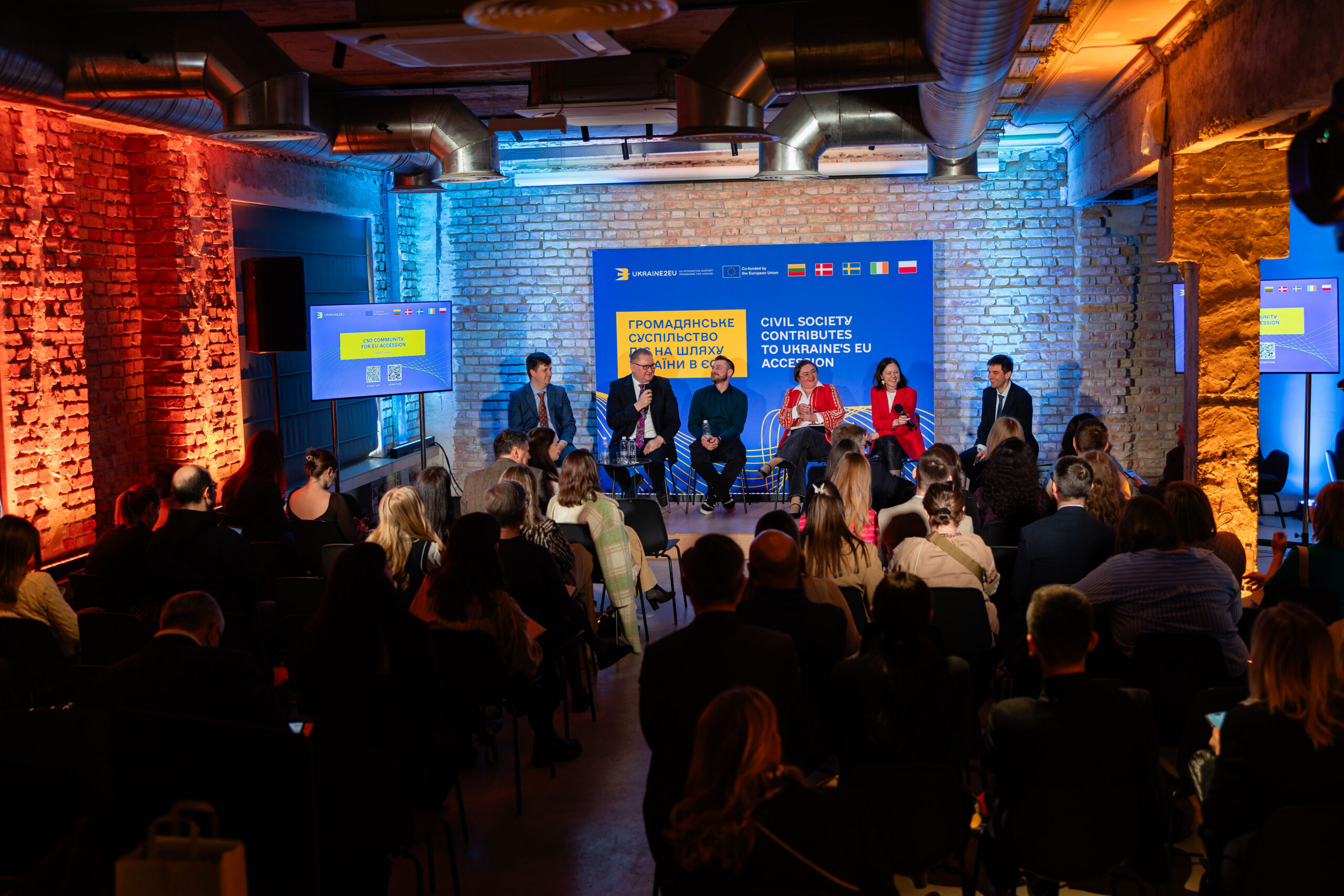
The project is implemented with the financial support of the Ukraine2EU Programme. The views and opinions expressed are solely those of the Agency for Legislative Initiatives and do not necessarily reflect the position of the Ukraine2EU Programme or the European Union.
ALI Presents Study on Prospects for Restoring Competitive Selection for the Civil Service during Martial Law
Suspending competitive selection was a necessary step for the civil service system at the start of the full-scale invasion. But what comes next amid martial law, active European integration and a growing staffing crisis? The Agency for Legislative Initiatives presented its vision in the study ‘Staffing of the Civil Service during Martial Law: Needs, Challenges and Prospects’ during a roundtable organised by the Verkhovna Rada Committee on the Organisation of State Power, Local Self-Government, Regional Development and Urban Planning. Together with MPs of Ukraine, representatives of state institutions and civil society, participants discussed:
- improving the procedure for entry into and service in the civil service;
- restoring competitions for civil service positions and service in local self-government bodies;
- proposals to the relevant Draft Law No. 13478-1, which is currently being prepared for the second reading.
International institutions emphasise that Ukraine shall return to competitive selection based on merit. Lawmakers are focused on meeting these requirements, while civil servants themselves do not always agree with these proposals. This is why the problem of staffing the civil service also needs to be viewed from within.
Oleksandr Zaslavskyi, Deputy Executive Director for Analytical Work at ALI, said that the study covers such aspects as civil servants’ internal assessment of the current system of selection for civil service positions, their needs and expectations, and possible approaches to addressing the problem of staff selection. In addition, the study contains recommendations on the legal regulation of selection for civil service positions.
The results show that civil servants have adapted to the current staffing model and have limited awareness of the potential benefits of competitive selection:
- the majority of respondents (57.2%) are satisfied with the absence of competitive procedures, while more than 55% believe that the absence of competitions fully ensures equality of access to positions;
- some respondents (26.3%) clearly understand the need for competitions and are waiting for them to be restored.
What explains these results? Factors include trust in the results of competitive selection and the uncertain status of civil servants appointed to positions without competitions. Currently, 42.8% of the civil servants surveyed believe that such persons may continue civil service without competition based on the results of performance appraisal.
A separate focus of the study is the prospect of adopting Draft Law No. 13478-1 in the near future. Civil servants’ expectations are rather cautious, but MPs note that restoring competitions is long overdue. Adoption of Draft Law No. 13478-1 on restoring competitive procedures would help fulfil one of the requirements of the Ukraine Facility Plan for 2024–2027. Restoring competitions is not only a matter of political expediency but also of evidence-based policy: what problems emerged during the period of simplified procedures, what risks are visible now and which models can work under martial law.
However, the staffing model is not the only factor shaping the professionalism, prestige and staffing stability of the civil service. Working conditions are no less important.
What model for restoring competitions would be fair, realistic and, at the same time, safe for the stability and functionality of the public administration system? It is now important to talk about the phased restoration of competitions, specific features for local self-government bodies and compliance with both Ukrainian realities and international standards.
Read more about ALI’s recommendations, stakeholders’ positions on the relevant draft law and the analysis of the current state and practice of selection for civil service positions under martial law in the new study.
Civilian Firearms Regulation: ALI Takes Part in Expert Consultations
The Agency for Legislative Initiatives (ALI) took part in expert consultations on the legislative regulation of civilian firearms held this week. The discussion brought together representatives of civil society and think tanks, the military, veteran and legal communities, as well as the media. The meeting was also attended by the leadership of the Ministry of Internal Affairs of Ukraine, MPs of Ukraine who are members of the Verkhovna Rada Committee on Law Enforcement, representatives of the NPU, the SSU, the SBI and the Office of the President of Ukraine.
The issue of firearms circulation among civilians remains sensitive and often subject to manipulation. At the same time, its proper regulation is important both for internal security and in the context of Ukraine’s European integration commitments under Chapter 24 of the EU acquis. Work should therefore continue on aligning Draft Law No. 5708 ‘On the Right to Civilian Firearms’ and Draft Law No. 5709 ‘On Amendments to the Code of Ukraine on Administrative Offences and the Criminal Code of Ukraine to Implement the Provisions of the Law of Ukraine “On the Right to Civilian Firearms”’ with European Union law, in particular Directive (EU) 2021/555 of the European Parliament and of the Council on control of the acquisition and possession of weapons.


The discussion also covered the right to self-defence, the classification of permitted types of firearms, clear grounds for their use by civilians and mechanisms for seizure in cases of threatening behaviour or domestic violence. Participants also addressed aspects related to building the necessary infrastructure, including theoretical and practical training, examinations and other requirements.
Olha Piskunova, Expert of the ‘Law and Order’ Area at ALI, emphasised the need for a systemic approach to addressing these issues.
The Agency has been working with the security sector for several years. As part of the Parliamentary Accountability of the Security Sector in Ukraine project (PASS Ukraine), ALI supported the Committee on Law Enforcement and the Committee on National Security, Defence and Intelligence. In partnership with the Parliamentary Centre (Canada), it also organised a study visit of the Law Enforcement Committee to Ottawa, where the key topics included military justice and parliamentary oversight of law enforcement agencies.
Throughout the project, ALI prepared a number of analytical materials, including legislative impact assessments and in-depth studies, on issues considered by the Committee on Law Enforcement. These included Draft Law No. 5708 on the right to civilian firearms, which the Verkhovna Rada adopted in the first reading back in February 2022. A comprehensive assessment of problematic aspects and support in developing optimal legislative solutions in this area will therefore remain an important focus of ALI’s work.
Implementation of the OAS on Law Enforcement Reform: ALI Participated in an Expert Group Meeting
The state of implementation of the Overarching Strategic Plan for Law Enforcement Reform is the focus of civil society discussion with relevant ministries and institutions. ALI joined a meeting of the Expert Group under the Coordination Council for Monitoring the Implementation of the Action Plan aimed at implementing the Overarching Strategic Plan for Law Enforcement Reform as part of Ukraine’s security and defence sector for 2023–2027.
Participants discussed the key challenges in implementing law enforcement reforms, civil society’s view of their progress, including the preparation of independent analytical assessments. They also jointly identified formats for future interaction between state bodies and civil society to develop and institutionalise dialogue.
Yevhen Krapyvin, Head of the ‘Law and Order’ Area at ALI, emphasised the importance of NGO participation in monitoring reforms and preparing independent analytical assessments. ALI has been preparing the Shadow Report assessing Ukraine’s implementation of its European integration commitments for the third consecutive year, including under Chapter 24, one of the measures of which concerns the implementation of the Overarching Strategic Plan.
At present, many public policy documents contain measures related to the reform of law enforcement agencies, while the OAS and its Action Plan are the most comprehensive. For example, the Rule of Law Roadmap and the State Anti-Corruption Programme for 2023–2025 also contain a number of measures in this area, so public authorities must properly coordinate their implementation of public policy measures.


According to Olha Piskunova, Expert of the ‘Law and Order’ Area at ALI, the process should begin with the development of a relevant draft law, which should be prepared using a comprehensive approach and in close cooperation with all stakeholders and the public. This would help ensure an orderly process for implementing the Priorities.


The event was attended by representatives of the Ministry of Internal Affairs, the Office of the Deputy Prime Minister for European and Euro-Atlantic Integration, the Prosecutor General’s Office and law enforcement agencies, as well as international partners and representatives of civil society institutions — human rights organisations, academics and analytical centres involved in monitoring law enforcement reforms.
The event was organised by the Ministry of Internal Affairs of Ukraine as part of the project ‘Reforming the Civilian Security Sector in Ukraine’, supported by the Government of the United Kingdom.
How Parliament Would Approve Peacekeepers in Ukraine
In recent months, discussions around peace negotiations have intensified significantly. This is particularly linked to the return to power of Donald Trump in the United States, who during his election campaign emphasised his desire to end the war and go down in history as a peacemaker. So far, however, we have only seen pressure on Ukraine and concessions to the Kremlin’s wishes.
Nonetheless, talk of a potential end to the war has not subsided, and the key question now is not whether negotiations are possible, but under what conditions they would take place. The most pressing and controversial issue at present is: what security guarantees can Ukraine receive?
While Ukraine continues to insist on NATO membership as a security guarantee, the more likely scenario at this point appears to be the deployment of peacekeeping units from the armed forces of other countries on Ukrainian territory. Such statements have already been made by political leaders in Denmark, Еstonia and the United Kingdom.
However, throughout the negotiation preparation process, the absence of Parliament is noticeable. Regardless of the scenario, the Verkhovna Rada of Ukraine — as the country’s sole legislative body — will be one of the key actors in adopting decisions on behalf of Ukraine.
So, what role would the Verkhovna Rada play in ending the war? And what actions must Ukraine take if agreements are reached on the deployment of foreign military contingents on its territory or the possible establishment of a buffer zone?
It is important to note that we are not advocating for or expressing support for this particular scenario of ending the war. Rather, we aim to broadly outline how such a scenario could be implemented and what role the Verkhovna Rada of Ukraine would play. This analysis is crucial in the context of potential political destabilisation and challenges to legitimacy that Ukraine may face in 2025.
In general, the establishment of a buffer zone is not new to Ukraine. In 2014, following the so-called Minsk Agreements, a “line of contact” was formed — essentially a buffer zone with opposing forces positioned on either side. Moreover, Ukraine has extensive experience in hosting foreign military forces, particularly those of NATO member states (albeit under the pretext of joint exercises). The key law enabling the presence of foreign armed forces on Ukrainian territory was adopted by Parliament back in 2000. However, this does not mean that the Verkhovna Rada’s involvement would be limited.
Let us consider scenarios in which a foreign military contingent might be present in Ukraine as a security guarantee. This could involve a UN contingent (1), a European Union force (2), or troops from individual countries (3). Each of these scenarios has its own specifics, but all require the conclusion of a peace agreement.
Such an agreement would provide a solid basis for Ukraine to appeal to the UN Security Council or the Council of the European Union to deploy peacekeeping forces on its territory. In the case of an agreement with individual countries, third parties would need to be involved, and zones, capabilities, and conditions for the deployment of foreign military units would have to be defined. These arrangements must be formalised through a multilateral international treaty. At the same time, the multilateral treaty must comply with the requirements established by Ukrainian law — that is, it must contain information on the composition, structure, and other characteristics of the foreign forces; the location and boundaries of deployment areas; and restrictions on the movement of their military and civilian personnel, among other provisions.
The next step is the adoption by the Verkhovna Rada of a law recognising the binding nature of such a multilateral treaty for Ukraine, in line with the requirements of the Law on International Treaties.
In this context, it is important to recall that it is Parliament that will ratify the treaty. According to subparagraphs 23 and 32 of Article 85 of the Constitution of Ukraine, it is the Verkhovna Rada that, by adopting a law, ratifies Ukraine’s international treaties and directly approves decisions both on sending units of the Armed Forces of Ukraine abroad and on admitting foreign armed forces to the territory of Ukraine.
Next, in the case of the first and second scenarios, the Verkhovna Rada must prepare an appeal to the United Nations Security Council or the Council of the European Union.
It is important to note that a resolution to deploy peacekeeping missions to a specific country must be supported by at least nine of the 15 members of the Security Council. Moreover, it must receive affirmative votes from all five permanent members — including the Russian Federation. Therefore, this scenario appears to be the least realistic.
The final step is the formation and deployment of military units from third countries on the territory of Ukraine as part of a peacekeeping mission.
It is essential that this entire process proceeds in a coordinated manner and in compliance with Ukrainian legislation. Therefore, Parliament must begin developing and adopting the necessary legislative acts in parallel with the start of negotiations. Particularly, this concerns the previously mentioned Law “On the Procedure for Admitting and the Conditions for the Presence of Units of the Armed Forces of Other States on the Territory of Ukraine”.
Among the most important amendments to this law, the following should be highlighted:
- Provide for the possibility of deploying troops from third countries for peacekeeping purposes. Currently, the law does not allow individual countries to deploy their forces to Ukraine for peacekeeping without a decision from the UN or the EU, although foreign armed forces may be admitted to fight alongside Ukraine against the aggressor.
- Regulate issues related to additional requirements for an international treaty, should the need arise; the use of real estate, Ukraine’s airspace, navigational, hydrographic, and informational support by the peacekeeping military contingent; the provision of utilities, household and other services; and the procedures for border and customs control for peacekeeping personnel.
Once agreements on peace (a truce) have been reached and there is clarity regarding which peacekeeping forces will be deployed on the territory of Ukraine, Parliament will need to adopt legislative acts to regulate the following issues:
- The definition and status of a buffer (demilitarised or sanitary) zone, including the delineation of its territorial boundaries.
- Rules for interaction between the peacekeeping contingent and Ukrainian state authorities and the civilian population residing (or present) in this zone.
- Conditions for the residence or presence of civilians in the zone.
- Rules governing the activities of Ukrainian state authorities and the provision of public, medical, and banking services to the population in this special zone.
- Business operations.
- The payment of taxes, duties, and other mandatory contributions in this territory.
All the aforementioned amendments to existing legislation — and the need for new laws — address only one issue: the deployment of peacekeepers. However, the challenges we will face after a ceasefire are far broader. The pace at which our negotiating positions are changing and the uncertainty surrounding the preparation process for these negotiations suggest that the work on legislative changes must begin now — as there may not be enough time later. The process is already under way, which is why the active involvement of Parliament is essential.
Status of Local Council Members: State of Play, Challenges and Solutions
The issue of the status of local members is becoming increasingly relevant: in 2017, the Agency for Legislative Initiatives already studied this matter and, in particular, developed Policy Proposals to Regulate the Status of the Local Council Members. On the other hand, enough time has passed, further changes have taken place in local government reform, and the regulation of the status of local members still requires special attention — and an update of the legislation in the light of current challenges.
The study was carried out in several stages:
- Desk study: analysis of legislative acts regulating the status of local council members; the study of the practical implementation of the Law “On the Status of Local Council Members” following the 2020 local elections, analysis of legislative initiatives to improve the status of local council members etc.;
- In June 2024, an online survey of local government representatives was conducted to assess the status of local council members. The survey involved 2,279 respondents from all regions of Ukraine. Of these, 94.7% were local government representatives; the majority of respondents — 67.2% — were or are members of local councils. Notably, most respondents represented the rural population: 33.6% of villagers, 21.4% of towns and 45% of city dwellers.
With the outbreak of full-scale Russian aggression, the problems in exercising local council members’ powers and in the regulatory framework for the status of local council members have become even more visible.
Currently, the following issues have been highlighted:
- The legislation contains inconsistencies in defining the representative functions of local council members: they are simultaneously considered representatives of the interests of the territorial community and of the voters in their constituency. However, a city district or regional council member does not represent the interests of the territorial community, as district and regional councils represent the common interests of territorial communities of villages, settlements and cities. A district or city council member represents voters’ interests within the territory of the district or city council.
- In 2022-2024, 19 pro-Russian political parties were banned in Ukraine by the courts. However, the current legislation does not provide for the automatic loss of mandates by council members elected on the lists of such parties and does not contain any restrictions on the powers of local council members in the event that a court decision banning a political party enters into force.
- The status of local council members is not defined in the legislation in the context of the transfer of powers of local self-government bodies to the relevant military administration and the temporary non-exercise of powers by local councils and local council members.
- The current legislation does not define the concept of ‘council member’s ethics’; instead, it lists insufficient rules for comprehensive legal regulation. Moreover, there are no sanctions for violation of these rules.
In addition to regulatory inconsistencies, there are other dangerous trends, such as a decrease in the number of local councils. Given the classified data on the state of local self-government under martial law, the situation with the full functioning of local representative bodies is potentially critical. The shortcomings identified point to the need to amend the legislation governing the status of local council members.
Read more about the problems and recommendations for optimising the status of local councils in Ukraine in the context of full-scale war — in the new ALI study.
The study was conducted within the framework of the project “Parliamentary Accountability of the Security Sector in Ukraine” (PASS Ukraine), which the Agency implements together with the Parliamentary Centre, in cooperation with The Verkhovna Rada of Ukraine, and with the support of Canada’s Foreign Policy—Global Affairs Canada as part of the Peacebuilding Program and stability (PSOPs).