
The five days full of seminars in Odesa ended, but the participants left even more motivated to study. We are already waiting for the next USPS session in Lviv!
Sustained Change Is Built through Daily Action: ALI Receives a Certificate of Honour from the Verkhovna Rada
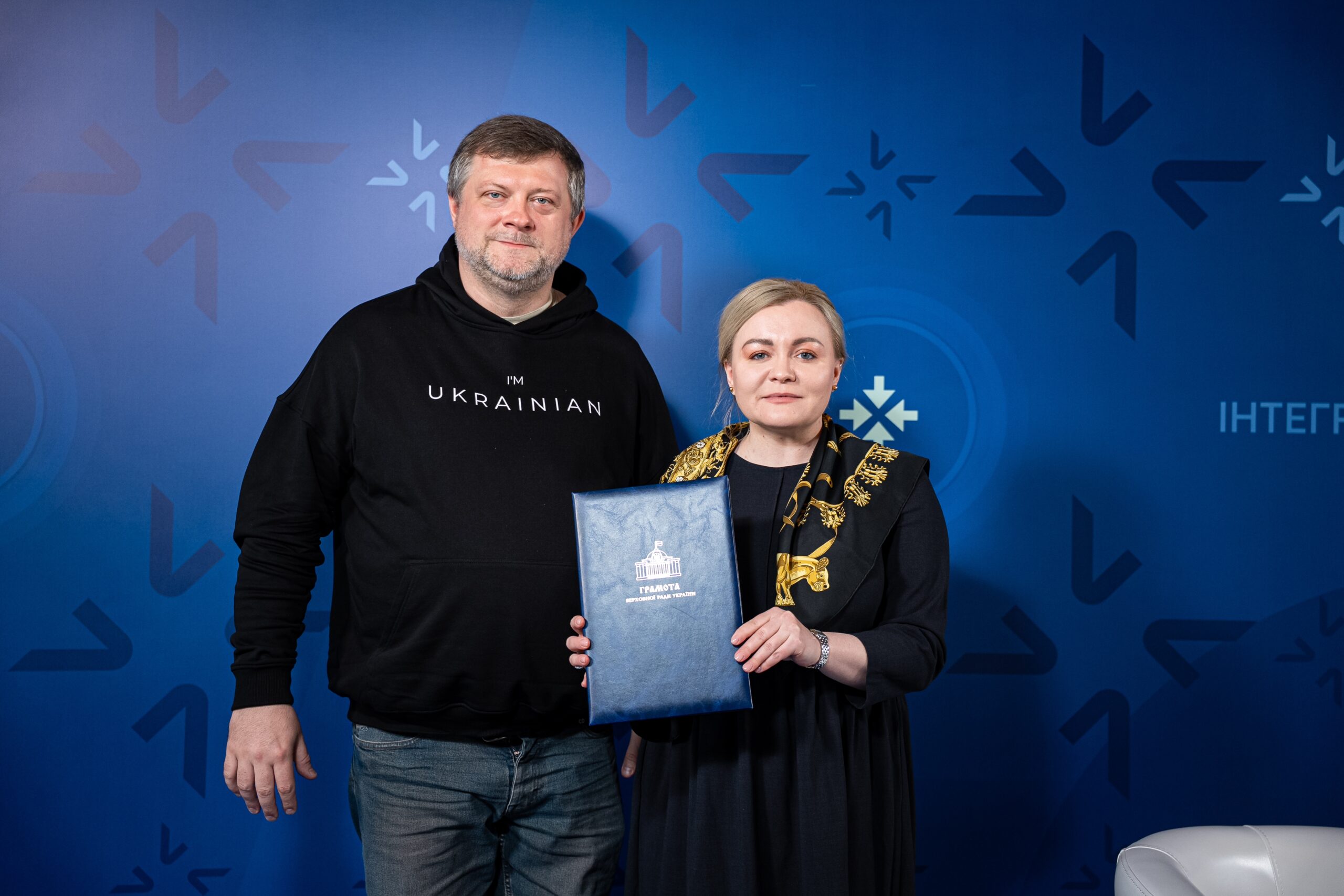
The team of the Agency for Legislative Initiatives (ALI) received the Certificate of Honour of the Verkhovna Rada of Ukraine during the First Session of the Ukrainian School of Political Studies’ landmark 20th programme. The School is an educational and networking project implemented by ALI under the auspices of the Council of Europe. The award was presented by Oleksandr Korniienko, First Deputy Chairman of the Verkhovna Rada of Ukraine and one of the Session’s speakers, in recognition of ALI’s significant contribution to the development of democracy and parliamentarism and the promotion of civic harmony in society.
For more than 26 years, ALI has helped build sustainable institutions in Ukraine and develop evidence-based public policy across a range of areas. ALI’s day-to-day work includes strengthening the institutional capacity of Parliament and the Government, advancing European and Euro-Atlantic integration, monitoring and supporting reforms in the justice and security sectors and providing political and civic education.
ALI regularly analyses the work of the Verkhovna Rada and its Secretariat through its session-by-session Parliamentary Monitoring reports and examines individual parliamentary processes in thematic issues of the Parliamentary Journal. We contribute to the development of draft laws and continue to monitor the implementation of parliamentary reform, a prerequisite for the institutional capacity of the Verkhovna Rada.
Background
The USPS programme explores different aspects of interaction between society and the state, including how these relationships are formed, how institutions and systems develop, what challenges they face and how those challenges can be overcome by taking responsibility and seeking solutions together.
Each year, changemakers from different fields join the USPS Community, including military personnel and entrepreneurs, politicians and civil servants, cultural figures and journalists. Learn more about the School, its values and its programme at this link.
Video Course with Oleksandr Zaslavskyi | Public Policy Analysis
The Ukrainian School of Political Studies is the educational and networking institution of the Agency for Legislative Initiatives, which brings together leaders through learning for the development of Ukraine. For over 25 years, the Agency has remained committed to and consistently implemented its educational mission, in particular through its flagship project in this field — the USPS.

The main purpose of the video course is to familiarise participants with the tools of public policy analysis and to promote the establishment of a tradition of evidence-based decision-making.
Video course with Oleksandr Zaslavskyi
Course Overview
Thematically, the lectures follow the policy cycle — from problem definition and the implementation of a solution to evaluation and, if necessary, policy change:
- Lecture 1: ‘What is Public Policy?’: An introduction to the terminology of the course: ‘policy vs politics’, ‘public vs state policy’, ‘public administration’, ‘the policy cycle’, ‘zero option’, ‘legislative tsunami’ and more. We outline the distinctive features of the Ukrainian decision-making system.
- Lecture 2. ‘Why Do We Need Public Policy Analysis?’: We highlight the value, key concepts, principles and approaches of policy analysis itself. We consider how to choose the most appropriate solution, how to calculate its expected and unexpected consequences, how to assess its effectiveness and ultimately understand why a decision was made and how it can be improved.
- Lecture 3. ‘How to Define a Problem?’: We begin with the first stage of the policy cycle and examine what constitutes a public problem, how it reaches the agenda and the relevance of the ‘three streams’ model; who the ‘stakeholders’ are; and what ‘framing’ means.
- Lecture 4. ‘Policy Formulation’: Using examples, we explore how to design and select a relevant policy option in such a way that it does not fall into policy capture. In other words, we follow the algorithm of the second stage of the cycle — policy formulation. We share tools that help to determine how and whether a particular decision should be implemented at all.
- Lecture 5. ‘Who Makes Decisions and How is Policy Implemented?’: This lecture moves through the third and fourth stages of the cycle: who makes decisions and how they are implemented. Overall, the fifth lecture reflects the real process of decision-making and assesses its impact from the beginning to the end of the cycle.
- Lecture 6. ‘Monitoring, Evaluation and Revision of Policy’: This lecture covers the final stages of the cycle — monitoring, evaluation, revision and communication of policy. In other words, we examine the tools that help to build a picture of a policy’s impact and make informed decisions on whether to continue, transform, scale up, revise or discontinue it. From the perspective of the last stage, we discuss when decision-makers should communicate the content, objectives and pathway of a policy. We also set out the principles of public policy communication that help to legitimise and, subsequently, improve policy initiatives.
Who should take this course?
These lectures are designed to benefit people from different walks of professional life, including:
- current and aspiring politicians, civil servants and representatives of the judiciary;
- analysts and experts involved in political processes and public administration;
- the civil society sector and media representatives;
- educators and students of relevant disciplines.
The video course is available via the link and on the USPS YouTube channel.
ALI Held a Seminar on Principles and Practices of Gender-Sensitive Legislative Impact Assessment for the Verkhovna Rada
On August 29, 2024, the Agency for Legislative Initiatives, together with the Parliamentary Centre (Canada), held a seminar for representatives of the Verkhovna Rada of Ukraine on the principles and practices of “Gender-Sensitive Legislative Impact Assessment: Canadian Experience and Prospects for Implementation in Ukraine.”
First Deputy Chairperson of the Verkhovna Rada of Ukraine Oleksandr Korniyenko opened the seminar and emphasised the importance of introducing such tools as legislative impact assessment and gender-sensitive analysis of draft laws into Ukrainian parliamentary practice:
“The principles of inclusiveness, equality and diversity should be taken into account when developing legislative initiatives. This is important both in the context of implementing the internal reform of the parliament and in fulfilling our European integration commitments. Therefore, the introduction of a gender-sensitive legislative impact assessment is one of the priority tasks for the Verkhovna Rada of Ukraine today”

Senior Project Manager at the Parliamentary Centre of Canada Anastasia Shtaltovna stressed that advocacy for gender equality is a constant priority for the Parliamentary Centre (Canada). She also thanked the ALI and the Verkhovna Rada for their ongoing cooperation in this area.
The event’s speakers were Oleksandr Zaslavskyy, Director of the analytical department at the Agency for Legislative Initiatives, and Rick Stewart, Executive Director of the Regulatory Governance Initiative and Co-Director of the Regulatory Career Development Programme at the School of Public Policy and Management at Carleton University (Canada).


Rick Stewart spoke about the principles and practice of legislative impact assessment and gender analysis (GBA+). The participants also discussed with the speaker the prospects of implementing gender-sensitive impact assessment in the Verkhovna Rada:
“Gender-sensitive analysis is an important aspect of another tool of parliamentary practice — legislative impact assessment. The effective application of these mechanisms can actually work to create policies that provide equal access to services and opportunities. After all, comprehensively predicting and evaluating how different people look at information and changes provided by this or that law is the main value in these processes”

Oleksandr Zaslavskyy told the participants of the training about the application of gender analysis through the experience of Ukraine and EU standards:
“Gender analysis is not a separate but a cross-cutting element in the decision-making system in Western democracies, which is an unconditional requirement of the European Union for Ukraine. Combined with legislative impact assessment, it makes it possible to determine how a particular decision may affect different people — and this requires the formation of a whole worldview in the decision-making process. I want to emphasise that these are not alien topics for the Ukrainian Parliament. In fact, one of the key activities of our project is piloting, adapting and institutionalising the gender-sensitive impact assessment methodology in the Verkhovna Rada of Ukraine”

The event was held by “Parliamentary Accountability of the Security Sector in Ukraine” (PASS Ukraine), which the Agency implements together with the Parliamentary Centre in cooperation with the Verkhovna Rada of Ukraine and with the support of Global Affairs Canada as part of Peace and Stabilization Operations Program (PSOPs).
Workshop on Legislative Impact Assessment and Its Application in the Context of Defence and Security Sector Reform
The legislative impact assessment is a tool for identifying and assessing the future consequences and likely impacts of proposed public policies. The Agency has been promoting this tool for a long time and helps the Parliament and the Government integrate it into their work, namely by organising specialised workshops and trainings for representatives of various government agencies.
On 21 June, an online workshop on legislative impact assessment and its application in the context of defence and security sector reform was held. The purpose of the workshop is to discuss the principles and practices of impact assessments with those directly involved in the development of legislation.
Workshop attendees:
- representatives of the Legal Support Department of the Ministry of Defence of Ukraine;
- representatives of the State Special Transport Service;
- representatives of the National Defence University of Ukraine;
- representatives of the Reforms Support Office of the Ministry of Defence of Ukraine.

The event was part of the project “Parliament and Accountability of the Security Sector in Ukraine” (PASS Ukraine), which the Agency implements jointly with the Parliamentary Centre of Canada, in cooperation with the Verkhovna Rada of Ukraine, and with the support of Global Affairs Canada within the framework of the Peace and Stabilization Operations Program (PSOPs).
Workshop on Principles and Practices of Legislative Impact Assessment
On Thursday, 30 May, ALI, with the participation of the VRU Committee on National Security, Defence and Intelligence, held a workshop on the principles and practices of legislative impact assessment.
The Agency continues to emphasise the importance of legislative process assessments as a tool for improving the quality of draft laws prepared by the Verkhovna Rada of Ukraine (VRU). Therefore, we actively work with committees and help them implement it in their work.
The visit was part of the project “Parliament and Accountability of the Security Sector in Ukraine” (PASS Ukraine), which the Agency implements jointly with the Parliamentary Centre (Canada) in cooperation with the Verkhovna Rada of Ukraine and the support from Global Affairs Canada within the framework of the Peace and Stabilization Operations Program (PSOPs).
Workshop on Principles and Practices of Legislative Impact Assessment
The legislative impact assessment is a tool that helps analyse and forecast the potential impact of formulated public policies. The introduction of this toolkit will help improve the quality of draft laws being prepared in the Verkhovna Rada. Its main goal is to pay more attention to the possible consequences of adopted laws and conduct a comprehensive analysis of the proposed changes.
On Friday, 23 February, the Agency, together with the Committee on the Organisation of State Power, Local Self-Government, Regional Development and Urban Planning, held a workshop on the principles and practices of legislative impact assessment.
The Agency remains a staunch supporter of the popularisation of the legislative impact assessment tool. That is why it promotes the organisation of educational events and training involving representatives of lawmakers.
The event was part of the project “Parliament and Accountability of the Security Sector in Ukraine” (PASS Ukraine), which the Agency implements jointly with the Parliamentary Centre (Canada), in cooperation with the Verkhovna Rada of Ukraine, and with the support of Global Affairs Canada within the framework of the Peace and Stabilization Operations Program (PSOPs).
Workshop on Principles and Practices of Legislative Impact Assessment
The legislative impact assessment is a tool that helps analyse and forecast the potential impact of formulated public policies. Sustained use of this tool and its popularisation allows the Agency to promote its implementation in the work of the parliament.
On 31 January, the Committee on the Organisation of State Power, Local Self-Government, Regional Development and Urban Planning held a workshop on the principles and practices of legislative impact assessment.
The workshop encompassed draft laws aimed at regional development and local self-government. Rick Stewart, Senior Advisor to our project, former Assistant Deputy Minister of the Government of Canada, and now a professor of legislative and regulatory impact assessment, joined the event. Rick Stewart assisted representatives of the committee in reviewing practical cases of legislative impact assessment.
The event was part of the project “Parliament and Accountability of the Security Sector in Ukraine” (PASS Ukraine), which the Agency implements jointly with the Parliamentary Centre (Canada), in cooperation with the Verkhovna Rada of Ukraine, and with the support of Global Affairs Canada within the framework of the Peace and Stabilization Operations Program (PSOPs).
USPS Alumni Programme
USPS has launched the first training module of our new educational format of two-day thematic courses for alumni.

The Ukrainian school of political studies is, first of all, Community, networking, and unity of differences. We are constantly emphasizing this, but we felt that we could do much more for the Community.
That’s how the USPS Alumni Program came about, a format that brings together alumni of different years and answers their demands for quality education through programs designed specifically for the Community.
To introduce the alumni to the format and test it, we simultaneously launched a set of four courses: literature, philosophy, economics, and political theory.

The first to start was a course on literature from Yevhen Stasinevych, a literary critic, curator, lecturer at many educational sites, and author of the book “The Price of the Question”. During the training module, the group talked about modern literature and the origins of bestsellers.
What do Conan Doyle’s stories have to do with urban development? How do post-war anxieties shape the cult of The Lord of the Rings and Ayn Rand? Why do too serious societies see what was not meant to be in the “Catcher in the Rye”? And how did the challenges of the 21st century, new and complex, fund Joan Rowling’s triumph?

After such a successful start of the new program, we will undoubtedly continue to develop the training format for alumni.
And these two days were very cozy, sincere, and meaningful.

The Second Session of the XV-XVI Program of the USPS
On September 8-12, the Ukrainian School of Political Studies hold the Second Session of the XV-XVI program in Odesa!

The second session is about socio-cultural ties, ethics, aesthetics, and expanding worldview. The program of the Session is always built to encourage participants to further search and reflections. This is a special session in a special place, it brings the group even closer and inspires them to learn new things.
Global art market and its impact on society

Art is first and foremost a culture and experience, but it is also an exclusive that people dream of owning. Therefore, art has become a large industry with its own rules and institutions.
Oleksandr Shchelushchenko – art dealer, founder, and director of contemporary art galleries “Tsekh” in Kyiv and Vilnius, as well as 2010 USPS program Alumnus, opened the art market world for participants and told about the structure of institutions in this field, the role of artist and critic, as well as why in Ukraine this industry still does not work properly. On the example of the gallery “Tsekh”, which is almost the only successful non-governmental cultural institution of contemporary art in Ukraine, Oleksander showed that we have a demand for art, so it is necessary to develop and transform the industry.
Ukraine, Europe, the world: a global view

What is Ukraine’s place in global history? What unites us with the history of Europe and other parts of the world, and what makes us unique?
For a long time, Ukraine in the international arena had the image of empty space – the Great Border. But with what do we identify ourselves? How does the world perceive us today, and what place do we occupy in it? How possible is for Ukraine the balance between liberalism and patriotism, between universal values and identity discourse?
The group discussed this with Volodymyr Yermolenko, a philosopher, writer, journalist, senior lecturer at NaUKMA, director of analytics at Internews Ukraine, and a member of the board of the International Renaissance Foundation.
Culture, politics, and ideology: history and modernity

Calls not to politicize culture are heard everywhere, especially from people for whom supporting a particular position means losing money. However, is it possible to stay out of politics in the eighth year of the war?
Politics is the art of solving problems here and now. It is focused on the present. And culture is aimed at the future. The artist’s goal is to overcome time.
But can culture be outside politics? Can it be just politics? Where are the limits of the artist’s responsibility, and where is the attention of politicians to art needed?
Tetyana Ogarkova, a senior lecturer at the Department of Literary Studies at NaUKMA and a lecturer at the Second Session of the USPS, discussed various concepts of cultural perception in the context of politics with the participants.
Future and liberty

We live here and now. Neither the future nor the past really exists. The past is a memory, the future is an expectation. This is what Augustine of Hippo thought about time. So what determines our future? Is it due to factors independent of us, or are we creating it ourselves, making a free choice? Is there freedom of will that allows such a choice? If free will does not exist, then what determines our actions, and are we responsible for them?
Vakhtang Kebuladze, philosopher, essayist, translator, professor of theoretical and practical philosophy at the Taras Shevchenko National University in Kyiv, held interesting discussions with participants about the future, time, science, our dreams, and fears about human freedom.
Bend Sinister: nature, context, and temptation of political populism

Ivan Gomza, candidate of Political Science, lecturer, and head of the Department of Public Administration of the Kyiv School of Economics and permanent lecturer of the USPS, conducted training for participants, which helped to understand what is the theory of political cleavages, why populism can be called a “subtle ideology” or political strategy, and how the polarization of society inhibits the development of states.
Political populism is a common concept in Ukrainian and world politics that we hear almost every day about. However, a correct understanding of the nature of this phenomenon and the context in which its promises become particularly tempting is not part of the debates on populism.
To better understand this phenomenon, it is necessary to turn to history and trace how and when political parties were born, because they eventually became an environment for the prosperity of populism. Ivan Gomza told the group about all this.
How (not) to read books through political optics?

Regardless of the era, books have always been of particular importance in human consciousness. Not reading and talking about it is always a loss of reputation. However, like culture in general, literature is often politicized by authors or readers themselves, who seek hidden meanings. Therefore, it is crucial to understand how to notice the political side of the book and when the view of the book through the prism of politics is appropriate, justified, and necessary.
Yevheniy Stasinevych, a literary critic and member of the renewed Shevchenko Committee, told our participants how to read rather than search for the political side of books and the author’s intention.
Political forecasting

No system can remain the same all the time, so it is necessary to analyze the systems and cycles inherent in them in order to make decisions and build policies. To predict events in a given system, it is first necessary to understand the difference between politics and policy, investigate which correlations, relationships, and dominants were present in previous cycles, and which markers had the most significant power.
How to approach the forecasting in a particular system? And how to distinguish professional forecasting from the forecasts of “experts” that we hear everywhere? Mykhailo Koltsov, Ph.D., World Bank Analyst, and Head of the Yu-Control Training Department, helped our participants to understand such a complicated issue.
Ukraine: a breakthrough strategy

Pavlo Sheremeta, manager-economist, co-founder of the Schumpeter School of Innovation, and Minister of Economic Development and Trade (2014), is convinced that a breakthrough is impossible without innovations and business development.
However, in Ukraine, business still exists not because of but rather against the state – entrepreneurs have no guarantees that their business will be protected from raiding. The country is experiencing a demographic crisis and an outflow of capital, which also does not contribute to entrepreneurship development, especially innovative. And for development to happen, the state must provide two things – first, security, and secondly, to give freedom of business.
What else needs to happen for Ukraine to make a breakthrough? What is the Creative Destruction and Blue Ocean Strategy? Pavlo Sheremeta discussed these issues together with the participants at the final platform of the Second USPS Session.

Results of the First Environmental Mentoring Program of Amalgamated Territorial Communities
On August 18, we launched the training of the first Program of Environmental Mentoring of amalgamated territorial communities. This year’s School of Community Leaders program has changed its format and now has three stages. The first was training for leaders that we have already conducted in June. Now the second stage is the seminars for mentors on environmental issues.

Over the course of three days, 30 selected mentors participated in panel discussions on a wide range of environmental issues: from separate waste sorting to energy sustainability of communities. Now that they have all the necessary knowledge and tools, the mentors will go to the communities we selected in the first phase and start working with the leaders during September-December this year.
Zero waste cities: from waste management to resource management

The concept of zero waste is about conscious consumption, about minimizing the amount of waste, giving preference to reusable items instead of “convenient” disposable ones – this is a necessity for the whole world and Ukraine in particular. But how can communities implement this concept?
Iryna Myronova, Executive Director of Zero Waste Lviv, Coordinator of ZW Cities, Member of the Board of Zero Waste Alliance Ukraine, shared her experience of initiating environmental change in the communities with mentors on the example of Lviv, a pilot zero waste city project in Ukraine.
Environmental Impact Assessment: How amalgamated territorial Communities and local governments can participate in ecologically important decisions

What are Strategic Environmental Assessment (SEA) and Environmental Impact Assessment (EIA)? How are these tools different, and how can civil society use them?
For successful work with EIA, it is important to understand the legal framework for environmental impact assessment, its stages, and features of public participation. Our mentors were helped to understand these complex issues by Maryna Shymkus, project manager of the European Business Association and an expert on SEA and EIA.
She told the Environmental Mentoring program participants the nuances of the environmental impact assessment procedure and the importance of civic control in the field of EIA.
Clean air in communities: responsibility, control bodies and levers of influence

In a few years, Ukraine has turned from a white spot on the map of Europe into a country with a developed system of equipment for air quality monitoring. Today, in just a few clicks, you can find out the air quality in almost any part of Ukraine, but how to reduce the level of air pollution?
Fine dust and emissions from large enterprises not only impair comfort – they cause a lot of diseases. Clean air is vital for people. Therefore, it is important to understand how the community and local authorities can monitor and control the environment, influence pollutants, and prevent violations of permitting procedures.
To answer all these questions, Artem Romaniukov, co-founder and director of development of Saveecobot and SaveDnipro and a 2018 USPS program Alumnus, shared with mentors successful cases of environmental control of enterprises and introduced them to the tools of air quality monitoring.
Energy sustainability of amalgamated territorial communities and how to improve it

Communities depend on energy. In addition, not everyone has learned to use energy effectively and, if possible, sparingly. Therefore, it is now important to explain to communities that energy efficiency is not only financially viable but also helps to avoid crises caused by natural disasters. Every community must have a crisis response plan and an uninterrupted power supply.
Andriy Zinchenko, the co-founder of the NGO Greencubator and a participant in this year’s USPS program, told the mentors where communities could get energy from, how to avoid crises, and become energy sustainable. And on the example of his project of the municipal energy cooperative Solar Town, he demonstrated that energy is a matter not only of big capital but also of local communities and groups of people.
Organization of two-stream separate waste sorting in cities: mixed and biological waste

The main reasons for improper waste management in Ukraine today are the lack of sorting skills, the absence of the necessary infrastructure, and misunderstanding of the extent of pollution and its consequences. Because of this, only 5% of waste is sorted in Ukraine.
Fortunately, we have people who care. They are developing a sorting culture in Ukraine. One of them is Artem Myrhorodskiy, CEO and founder of the GreenAge project, CEO of BioBin, and a 2007 USPS Alumnus.
From his own experience, he told how to turn waste sorting into a profitable business. There is a demand for processing and sorting in society, we just need to provide people and businesses with convenient tools for this.
Water health of your community

Clean water is another vital condition for the development and functioning of communities. According to a study by the United Nations Development Program (UNDP Ukraine) for 2020, water pollution and poor drinking water quality is an environmental problem №1 that worries Ukrainians.
How to solve “water” problems in Ukraine? Where to start? Mariana Hinzula, a water protection expert, worked on this with environmental mentors.
According to the speaker, the revival of water bodies of the territory is one of the key issues of community development, which will allow solving the numerous ecological and socio-cultural problems of the territory. However, the rescue of reservoirs requires a systematic and professional approach. There are no unsolvable environmental problems, but everything has a price. For the preservation of reservoirs, we’ll have to pay – not only money but also the time and effort of the people who are not indifferent about this problem.
Adaptation of amalgamated territorial Communities to climate change


In recent years, we have all seen climate change in Ukraine: abnormal heat, floods in the cities, and increasing fires. Therefore, adapting to these changes is a serious challenge for communities now.
Olena Maslyukivska, Associate Professor of Ecology at NaUKMA, curator of the Environmental Mentoring Program for Communities, and a 2008 USPS Alumna, conducted an interactive training for our mentors on environmental issues on adaptation to climate change.
How much will climate change in Ukraine? How will climate change affect Ukrainian communities? What are the challenges of climate change? How to help the communities adapt to these changes, and how to work properly with the stages of the adaptation cycle?
Open data on about the environment and waste in the circular economy

Working with open data is a popular and effective trend in many areas. In 2014, working with open data even appeared in the anti-corruption strategy. And in 2015, the Cabinet of Ministers approved Resolution №835, which determined which data sets are subject to disclosure in the form of open data.
The benefits of using open data in environmental matters may not be obvious to everyone at first glance, but working with them makes it much easier to solve many environmental problems.
Andriy Hnap, co-founder and data analyst at Waste Ukraine Analytics, told our mentors about this extremely difficult topic. Andriy managed to explain in the most accessible and easy way how to work with open data on the state of the environment.
Biodiversity and ecosystem services: community involvement

From 1970 to 2016, the decline in the population of the species increased to a staggering 68%. This has contributed to biodiversity loss being ranked 4th among global risks in terms of impact.
Mankind needs to stop the careless use of ecosystem services and switch to nature-oriented solutions – that is, to focus efforts on the protection, effective management, and restoration of natural or modified ecosystems.
Olena Tarasova, UNDP Ukraine Project Manager and Expert, told the mentors how to do this and how to involve communities in the transition to nature-oriented solutions. She shared her experience working with communities and tools to involve amalgamated territorial communities in biodiversity conservation.

Now we move on to the 3rd stage of the project – the cooperation of mentors and communities. This is the longest and most difficult stage, but we believe that communities will feel the changes for the better by the end of this year.
We hope that this project will be an impetus for communities not to stop but to take more care of the environment after the end of the program. If this experience is successful, we plan to expand mentoring support to communities in other areas, so we are already waiting for the third stage of this year’s project.